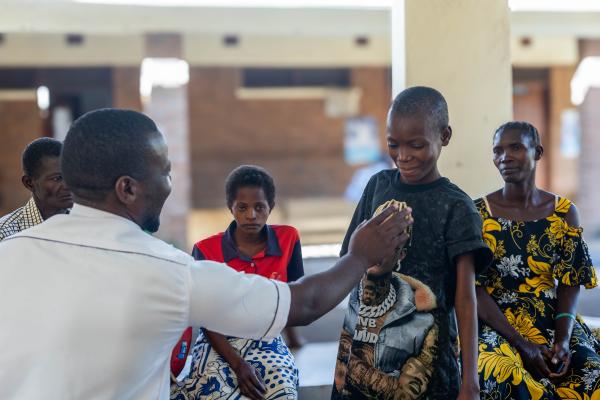
Globally, nearly one in nine adults (589 million) are now living with diabetes, and an estimated 252 million are not yet aware they have the condition, placing them at higher risk of serious complications and early death. 15-year-old Tiyamike Mhango from Karong District was among those living with the condition but unaware before diagnosis. His mother, Towera Mhango, remembers moving from one hospital to the next seeking for answers to her son’s condition.
The Panic
Towera recalls one night watching her son laying unresponsive before rushing him to Nyungwe Health Center, a desperate final attempt to save a child who had slipped into a deep, diabetic coma. At the facility, they were referred to Karonga District Hospital for proper care and she recalls the 70-kilometer journey from their home in Kapiyira Village, which felt like an eternity. She watched her son, a standard five learner, fading away, his body ravaged by a condition no one in their family had ever heard of, let alone faced.
Just months earlier, Tiyamike had been a typical teenager, but the sudden onset of confusing spells, persistent hunger, and rapid weight loss had reduced him to a skeletal 24 kilograms, stripping him of his energy and his ability to attend school.
The Diagnosis
That fateful night marked the beginning of a brutal fight for survival. Diagnosed with Type 1 Diabetes in June 2025, Tiyamike’s life became a battle between life and death. As a subsistence farming dependent family with limited education, his parents were thrust into a world of insulin injections, blood sugar monitoring, and dietary restrictions. The initial months were a nightmare of repeated hospitalizations. Between July and December 2025, Tiyamike was admitted at least four times. He needed close monitoring, but they live far from the nearest district hospital.
Managing his condition felt impossible, as he struggled with proper injection techniques, erratic dosing, and the challenge of maintaining a stable diet at home. His mother watched helplessly as her son’s childhood slipped away, replaced by hospital gowns and the sterile smell of wards.
But Tiyamike’s story is not one of tragedy, rather of triumph, made possible by a powerful partnership between Partners In Health (PIH) Malawi and the Ministry of Health. In the thick of his crisis, the dedicated medical team at Karonga DHO, led by mentors like NCD Coordinator Luckson Chiphiko, refused to give up. When Tiyamike arrived unconscious with a blood sugar level reading simply as “Hi,” they administered emergency IV fluids and insulin infusions. For six to seven hours, they fought to bring him back, and slowly, the veil of unconsciousness lifted.
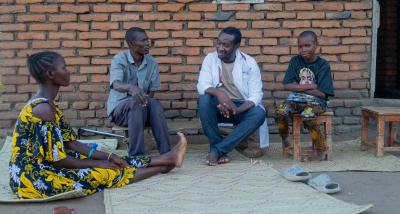
Karonga District Hospital NCD Coordinator, Luckson Chiphiko, chatting with Tiyamike’s parents during a home visit
Innocent Nyambalo/PIH
PIH Malawi’s Involvement
PIH Malawi’s support had been instrumental in equipping these health workers with the advanced training and resources needed to handle such critical pediatric cases, bridging the gap between primary health centers and secondary care facilities so that referrals like Tiyamike’s could be handled with precision.
The turning point came through consistent, compassionate counseling. With every admission, the team worked tirelessly not just to treat his symptoms, but to educate him and his family. They patiently taught Tiyamike how to accept his new reality and take ownership of his health. The results have been miraculous. Since January 2026, he has had only one admission, and his blood sugar levels are now consistently below 200 mg/dL. The boy who once lay exhausted now weighs more than 28 kilograms and has regained his physical strength. More importantly, he has reclaimed his youth. He is able to attend classes; he is active, bright, and living like a normal teenager again.
This dramatic turnaround is a direct result of the NCD clinic that PIH constructed and handed over to Karonga DHO in 2025 with financial support from World Diabetes Foundation (WDF) to ensure that life-saving care is accessible to the most vulnerable. Through the PEN-Plus initiative, which began ramping up in 2022, facilities like Karonga DHO are no longer just managing diabetes but also aggressively treating complex, severe NCDs that once had no local recourse.
PIH has been pivotal in this shift, orienting health workers at the primary level, ensuring a steady supply of insulin, providing critical data collection tools, and spearheading community awareness campaigns that bring screening directly to remote villages.
Persisting Challenges in NCD Care
However, the journey is far from over, and the challenges remain sobering. As Luckson Chiphiko reflects on Tiyamike’s progress, he acknowledges that “diabetes in children is difficult to handle,” especially without a family history to guide them. He considers Tiyamike one of their greatest successes, but he also voices a pressing truth: the supply of medication is not always consistent and the resources available are stretched thin against a growing tide of NCD patients.
There is a profound need for social support to ensure that the healing that happens in the hospital continues at home. While Tiyamike has beaten the odds, the fight for the sustainability of insulin and glucosticks continues, a testament to why PIH and relevant stakeholders must join hands with the Ministry of Health in ensuring the availability of drugs for NCDs and other conditions in public health facilities.
PIH’s Intervention on NCDs in Malawi
In 2024, PIH Malawi also constructed and officially handed over NCD Clinic to Salima DHO with funding from WDF. In 2025, PIH constructed 3 more NCD clinics at Ntchisi, Rumphi and Mangochi District Hospitals with funding from UNICEF. These facilities operate under the PEN-Plus model that decentralizes care for complex chronic diseases such as type 1 diabetes, sickle cell disease, heart failure, and rheumatic heart disease from tertiary hospitals to district and community hospitals, which is significantly improving access to specialized care for people living with chronic and complex NCDs in these districts.
According to the PIH Malawi’s Chief Medical Officer, Dr. Henry Ndindi, highlighted the growing burden of NCDs in the country and the importance of partnerships in strengthening the health system. “Malawi has a predominantly young population, with over 50% under 18 years, and the burden of NCDs among children and adolescents is rising. Yet resources, infrastructure, and training for NCD care remain scarce, particularly in rural areas, hence the need for the PEN-Plus initiative,” he said.
Dr. Ndindi reaffirmed PIH’s commitment to working with the government of Malawi and other partners to strengthen pediatric and chronic NCD services through policy guidance, technical support, training, and mentorship. So far, the clinics are reducing overcrowding in tertiary facilities, and gives families renewed hope by providing care closer to their communities.
Speaking during the handover ceremony of the NCD clinic at Mangochi, the Principal Secretary in the Ministry of Health, Dr. Dan Namarika, commended PIH Malawi for its continued role in strengthening Malawi’s health system. He encouraged other stakeholders to follow suit and help the ministry to strengthen health care system and ensure that no one is left behind in accessing essential healthcare.
PIH Malawi started implementing Integrated Chronic Care Clinic (IC³) in Neno District in 2015 where it rolled out to all health centers and hospitals with around 8,000 actively enrolled patients. The Integrated IC³ provides longitudinal care for patients with an array of chronic diseases including HIV and common NCDs, allowing for a single visit for all of a patient’s conditions. This initiative helps in reducing stigma against those living with HIV and TB as no one knows the condition each client is being assisted on as all come on same days. On the other hand, it helps clients with more than one condition to save on time and transport fee as they receive all the care during one visit.
Join us in advocating for and providing equitable access to health care services to all.